SISTEMA DE BASTÓN NO SEÑALIZADO
NOT SIGNALIZED STAFF SYSTEM
La Movilización con Bastón se utiliza en
secciones de simple vía, y significa que para que un tren viaje desde una Estación a otra, el maquinista debe tener
en su poder un Bastón correspondiente a ese tramo.
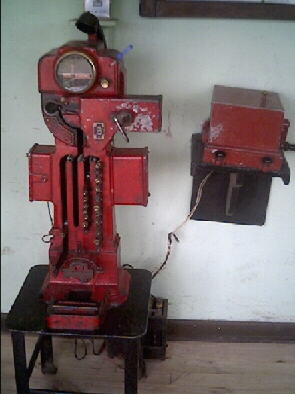
El Bastón se encuentra dentro del Aparato Staff, y para sacarlo de ahí, el Movilizador de la
Estación adonde irá el tren, debe accionar un sistema eléctrico en su Aparato Staff.
Una vez que se ha sacado un Bastón, el sistema se bloquea y no se puede sacar ningún Bastón más, en ninguna de las dos
Estaciones, hasta que el Bastón que se sacó sea repuesto, en cualquiera de las dos
Estaciones.
Junto con sacar el Bastón, se desbloquea una Llave que se encuentra en el Aparato Staff, la que permite accionar la
Señal de Salida.
In the Staff system the train that go from one station to another, must have a staff of this section. The staff is inside the Staff instrument and there are staff instruments at each end of a single line section, electrically interlocked so that the act of removing a staff locked both machines and prevented further removals from either instrument until the missing staff was replaced at one end or the other. Together with removing the staff, a Key is released from the Staff instrument, that permits to drive the exit Signal.
Aparato Staff. Foto de Víctor Cerda
Otra foto de Edgardo Maza
Otra foto de Ernesto Vargas

Tipos de Bastones utilizados. En permisivo podían viajar varios trenes en una misma dirección con el mismo bastón dividido, pero a raíz de gravísimos accidentes, actualmente sólo se permite un tren seguido de motocarriles o buscarriles.
Staff types utilized. In permissive can travel several trains in a same direction with the same staff divided, but because of very serious accidents, at present only one train is permitted followed by motorails or railbuses.
COMPONENTES DE UNA SEÑAL
SIGNAL COMPONENTS

Este sistema con Señales de Aspas llamadas Semáforas iguales a las utilizadas en el sistema telefónico o telegráfico, sólo que para accionarlas se requiere la llave del aparato staff, se utilizó en toda la red ferroviaria principal, siendo posteriormente reemplazado por sistemas señalizados en las rutas de mayor circulación. Aquí no existe circuito-vía (sistema eléctrico que informa si la vía está o no ocupada) y los cambios son de paleta, y para autorizar el viaje de un tren desde una estación a otra se utiliza el aparato Staff o Bastón. Para el movimiento de trenes dentro de la estación se utilizan señales de mano, con banderas o linternas accionadas en el terreno.
Para entrar a la estación también se utilizan señales de mano que hace el cambiador junto al cambio puntero de la estación, aunque algunas estaciones importantes poseen señales de entrada y salida en los extremos de la estación, las que complementan las señales de mano.
This system with arm Signals called Semaphores like the signals of the telegraphic or telephonic system, only that to drive them is necesary the staff instrument key, was utilized in all the main railway network, being subsequently replaced by signalized systems in routes of greater circulation. Here are not rail-circuit (electric system that detects track occupancy) and there are palette turnouts, and to authorize the trip of a train from a station to another is utilized the Staff instrument. For shunting inside the station flags or lantern signals are utilized. To enter to a station also flags or lantern signals are utilized. Some important stations have entrance and exit signals at extremes of the station.
La señal que vale es la de la izquierda en el sentido de la marcha del tren, y a diferencia de los sectores señalizados, aquí estas tienen valor tanto en su vista anterior (cuando el tren se aproxima a la señal), como en su vista posterior (cuando el tren se aleja de la señal)
The signal that worths is that at left in the sense of the march of the train, and contrary to signalized sectors, here the signals value in its front view (when the train approaches the signal), and in its rear view (when the train moves away of the signal)
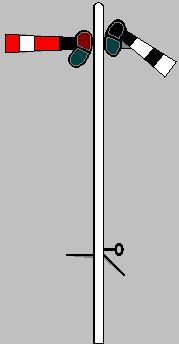
Vista posterior de la misma señal. En este caso la señal que vale es la de la izquierda en el sentido de la marcha del tren (que vemos a la derecha)
Rear view of the same signal. In this case the signal that is value is at left in the way of the march of the train (that we see at right)
El significado de las Aspas (señal diurna) y Luces (señal nocturna) es el siguiente / The meaning of the Arms (diurnal signal) and Lights (nocturnal signal) is the following
Aspa Roja y Blanco abajo o luz Verde: Avanzar / Red and White or Yellow and Black Arm Down or Green light: Proceed
Aspa Amarilla y Negro arriba (horizontal) o luz Amarilla: Avanzar con precaución a velocidad restringida / Yellow and Black Arm Up (horizontal) or Yellow light: Proceed carefully, restricted speed
Aspa Roja y Blanco arriba (horizontal) o luz Roja: Detención / Red and White Arm Up (horizontal) or Red light: Stop
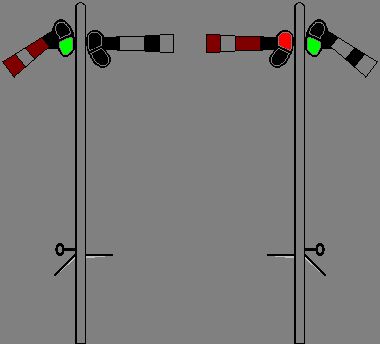
Visión nocturna. Vista anterior y posterior de la misma señal. La luz verde se ve por ambos lados, en cambio la luz roja, que en este caso vale para un tren en sentido contrario, sólo en la vista anterior de dicho tren / Nocturnal view of the signal. Front and rear view of the same sign. The green light is seen from both sides, on the other hand the red light, that in this case is worth for a train in contrary way, only in the front view of that train
En las imágenes siguientes combinaremos la visión diurna y nocturna en la misma imagen sólo con fines didácticos
In the following images we will combine the nocturnal and diurnal view in the same image only for didactic purposes