

SEÑAL DE SALIDA DE UNA ESTACIÓN
EXIT SIGNAL OF A STATION
La señal de salida está normalmente al centro de la estación, frente a la oficina del Jefe de Estación. Es accionada por el Jefe de Estación, pero previamente debe llenar de el formulario de Vía Libre entregar una copia al maquinista.
The exit signal is normally at middle of the station, front the office of the Station Chief. It is driven by the Station Chief, but previously he must write the Free Way form and delivers a copy to the train operator.
Vistas anterior y posterior de la misma señal / Front and rear view of the same signal
Detención / Stop
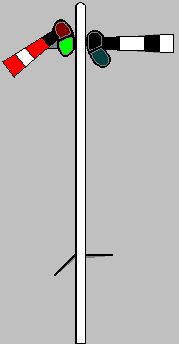
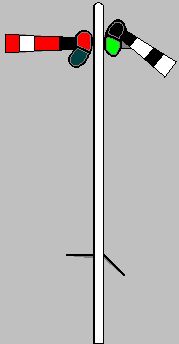
El tren puede avanzar, pero sólo si el maquinista tiene en su poder el Formulario de Vía Libre está autorizado para seguir hasta la Entrada de la Estación siguiente. Si se trata de maniobras se le entrega un formulario de Precaución para Maniobras al maquinista y es accionada la señal, y el tren está autorizado para pasar el último cambio sólo por la distancia que exija la maniobra.
The train can advance, but only if the operator has in its power the Free Way form is authorized to continue to the Entrance of the following Station. In shunting is delivered a Precaution form for shunting, and the train is authorized to pass the last turnout only by the distance that need the shunting.
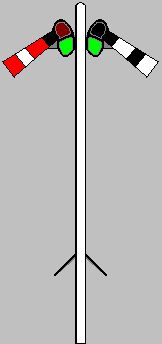
Dos trenes en la estación pueden avanzar, uno en cada sentido, pero sólo si tienen el Formulario de Vía Libre pueden seguir a Estación siguiente. Si se trata de maniobras se les entrega formulario de Precaución para Maniobras y son accionadas la señales, estando autorizados para pasar el último cambio sólo por la distancia que exija la maniobra.
Two trains in the station can proceed, one in each way, but only if they have the Free Way forms they can continue to the following Station
En las estaciones terminales las semáforas son de un aspa / In terminal stations de signals have only one arm.


Detención / Stop

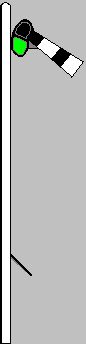
El tren puede avanzar, pero sólo si tiene formulario de Vía Libre pueden seguir a la Estación siguiente. Si se trata de maniobras se entrega formulario de Precaución para Maniobras, y el tren está autorizado para pasar el último cambio sólo por la distancia que exija la maniobra.
Trains can proceed, but only if have the Free Way form it can continue to the following Station

Estación La Cruz en el Siglo XIX, con la primera señalización utilizada en Chile con semáforas de un aspa. Todas las estaciones del ferrocarril de Santiago a Valparaíso eran iguales a esta, (con excepción de las principales), y precisamente La Cruz es la única que se aún existe por lo que es indispensable que sea preservada.
La Cruz Station in the 19th Century, with the first signal used in Chile with semaphores of one arm. All stations from Santiago to Valparaíso railroad were like this, (with exception of the main stations), and La Cruz is the only one that still exist for which is important that be preserved.
El ferrocarril Militar de Puente Alto a El Volcán tenía su propio código de colores de Aspas. A los trenes que subían a El Volcán les correspondía el Aspa Roja y a los que bajaban a Puente Alto el Aspa Azul
The Military railroad from Puente Alto to El Volcán had its own color code of Arms. To the trains that goes to El Volcán is the Red Arm and to the ones that goes to Puente Alto is the Blue Arm

Estación San José de Maipo

Estación La Obra